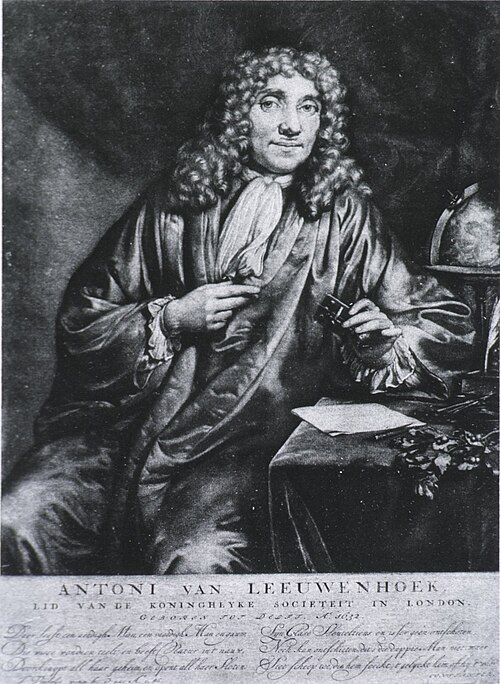
Antonie van Leeuwenhoek, portrait by Jan Verkolje, 1686Jan Verkolje (1650—1693), 1686. Public domain. Wikimedia Commons. Image source
Antonie van Leeuwenhoek sees tiny animals
1670s · Antonie van Leeuwenhoek (1632 to 1723)
Antonie van Leeuwenhoek was a cloth merchant in Delft, in the Netherlands. Merchants used lenses to check the quality of thread, and he became skilled at grinding and shaping his own tiny lenses.
His single-lens microscopes were small metal plates with one bead-like lens. They could magnify around 200 times or more, better than other microscopes of his time.
In the 1670s he looked at pond water, rain water and scrapings from his own teeth. He saw tiny moving creatures he called animalcules. He was describing single-celled organisms and bacteria for the first time.
He also described red blood cells, sperm cells and blood moving through tiny vessels. He sent hundreds of letters about what he saw to the Royal Society in London, which made him a member in 1680.
Leeuwenhoek is often called the father of microbiology. Every blood film and urine sediment looked at under a microscope in a lab today follows the path he started.
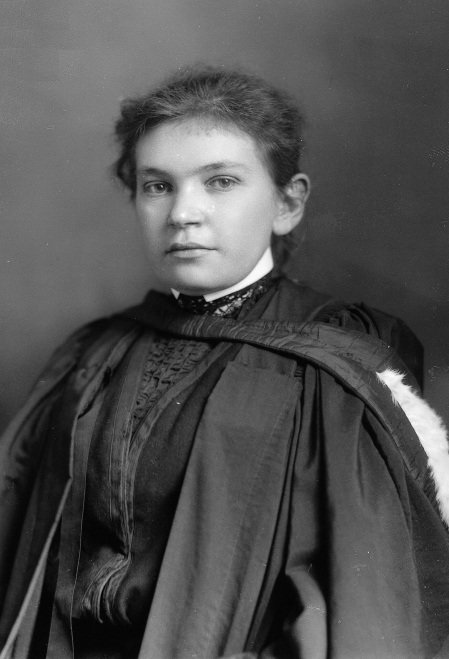
Dr. Maude Abbott, Montreal, 1904, Wm. Notman and SonWm. Notman & Son, 1904. Public domain. Wikimedia Commons. Image source
Maude Abbott builds a museum of hearts
1898 to 1936 · Maude Abbott (1869 to 1940)
Maude Abbott graduated from McGill University in Montreal in 1890, but McGill's medical school did not accept women. She earned her medical degree from Bishop's College in 1894.
In 1898 she became assistant curator of McGill's medical museum. It held hundreds of specimens that were poorly labelled. Abbott sorted, catalogued and described them so that students could learn from them. Careful labelling and records became her trademark.
Through the specimens she became fascinated by hearts with defects present at birth. She studied about 1,000 cases and, in 1936, published the Atlas of Congenital Cardiac Disease. It became a key reference for doctors and later helped surgeons develop operations for these conditions.
McGill gave her an honorary medical degree in 1910. She is now honoured in the Canadian Medical Hall of Fame.
Her work shows how much good specimen handling, labelling and record keeping matter, the same skills a medical lab assistant uses every day.