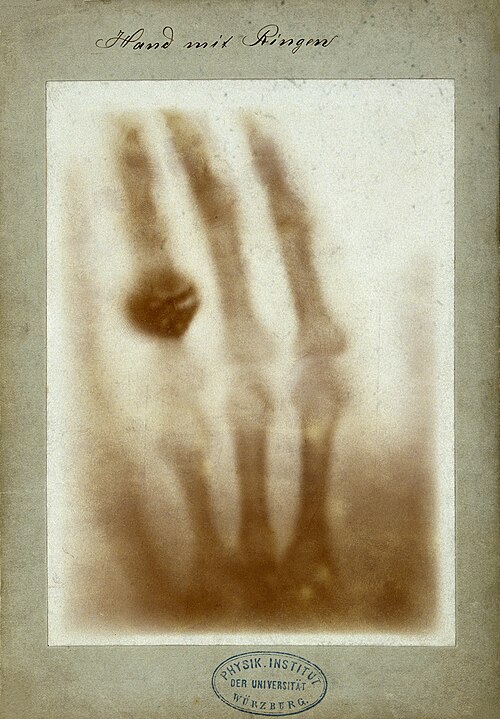
Röntgen's X-ray of Anna Bertha Ludwig's hand, 1895Wilhelm Röntgen, 1895-12-22. Public domain. Wikimedia Commons. Image source
Wilhelm Röntgen discovers X-rays
1895 to 1901 · Wilhelm Conrad Röntgen (1845 to 1923)
In November 1895 Wilhelm Röntgen was experimenting with a glass tube that carried an electric current, in his lab in Würzburg, Germany. He had covered the tube with black card, yet a screen coated with a special chemical across the room began to glow.
Some unknown ray was passing through the card. Because he did not know what it was, he called it X-rays. He found that the rays passed through paper, wood and flesh but were stopped more by bone and metal.
On 22 December 1895 he made an image of his wife Anna Bertha's hand. It showed her bones and her ring. Within weeks, doctors around the world were using X-rays to find bullets and broken bones.
Röntgen received the first Nobel Prize in Physics in 1901. He chose not to patent his discovery so that everyone could use it.
Early workers did not know X-rays could cause harm, and many were injured. Shielding, distance and short exposure times, the basics MRTs use every day, came from those hard lessons.
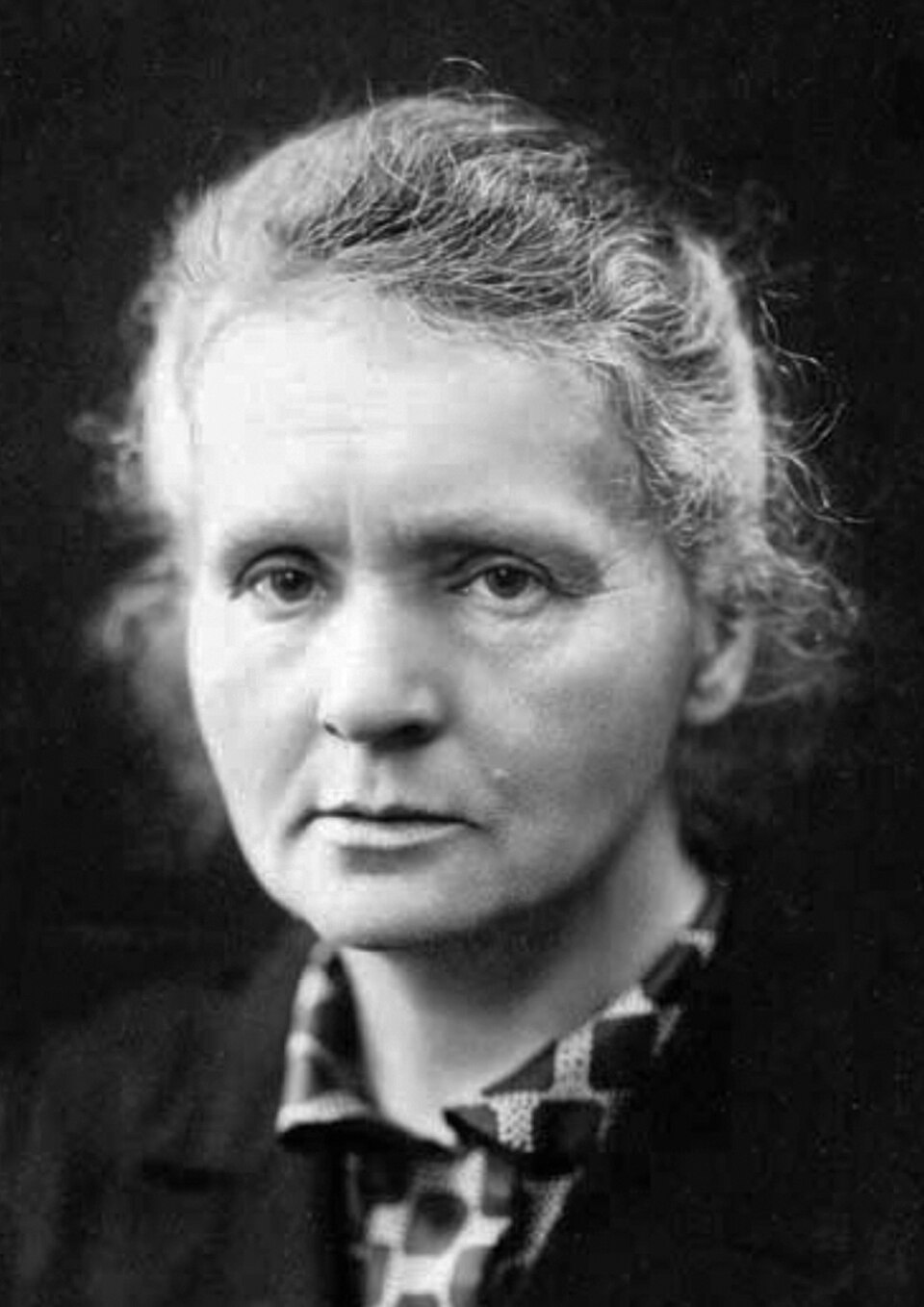
Marie Curie around 1920, photo by Henri ManuelHenri Manuel, circa 1920date QS:P,+1920-00-00T00:00:00. Public domain. Wikimedia Commons. Image source
Marie Curie takes X-rays to the front
1898 to 1918 · Marie Curie (1867 to 1934)
Marie Curie was born in Warsaw, Poland, and moved to Paris to study. With her husband Pierre she studied radioactivity, a word she helped make common. In 1898 they discovered two new elements, polonium and radium.
She won the Nobel Prize in Physics in 1903, shared with Pierre and Henri Becquerel, and the Nobel Prize in Chemistry in 1911. She was the first person to win Nobel Prizes in two sciences.
When the First World War began in 1914, Curie saw that wounded soldiers needed X-rays near the front to find bullets and fractures. She helped equip vehicles with X-ray machines, often called little Curies, and trained women to run them. She sometimes drove them herself.
Radium was soon used to treat cancer, an early step toward radiation therapy.
Curie handled radioactive materials for decades without protection, and she died in 1934 of a blood disease linked to that exposure. Her story is both a celebration of discovery and a reminder of why radiation safety matters.