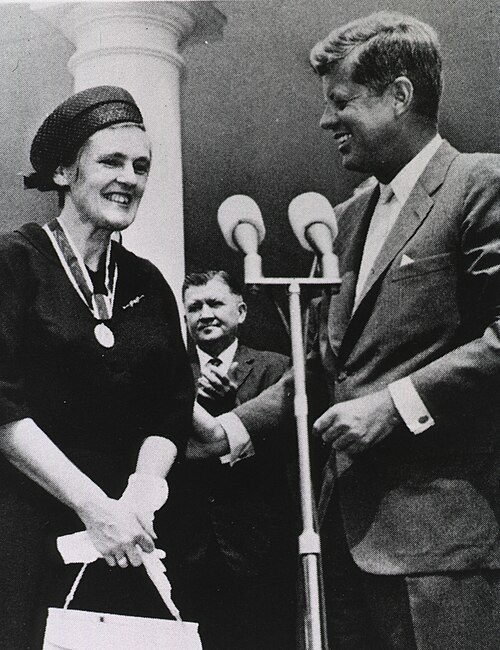
President Kennedy honours Frances Kelsey, 1962Unknown (U.S. government photo), 1962. Public domain. Wikimedia Commons. Image source
Frances Kelsey says no to thalidomide
1960 to 1962 · Frances Oldham Kelsey (1914 to 2015)
Frances Oldham was born in Cobble Hill, British Columbia, in 1914. She studied pharmacology at McGill University and earned a PhD at the University of Chicago.
In 1960 she started work at the United States Food and Drug Administration. One of her first files was an application to sell thalidomide, a sleeping pill already sold in many countries, including for morning sickness in pregnancy.
Kelsey felt the safety data were weak. She asked the company for more evidence, again and again, despite strong pressure to approve it.
By late 1961, doctors in Europe linked thalidomide to severe birth defects in thousands of babies. Canada had approved the drug in 1961 and did not fully withdraw it until 1962, and many Canadian families were affected. In the United States, because of Kelsey's caution, it was never approved for sale.
In 1962 President John F. Kennedy gave her an award for distinguished federal service, and drug laws were tightened. Her story shows why checking, questioning and reporting concerns are key parts of every pharmacy technician's role.
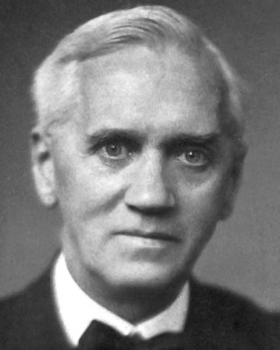
Alexander Fleming in 1945Nobel Foundation, 1945. Public domain. Wikimedia Commons. Image source
Alexander Fleming notices a mould
1928 to 1945 · Alexander Fleming (1881 to 1955)
In September 1928 Alexander Fleming, a Scottish scientist working at St Mary's Hospital in London, returned from a holiday to find a mould growing on one of his dishes of Staphylococcus bacteria. Around the mould, the bacteria had been killed.
Fleming identified the mould as Penicillium and named the substance it released penicillin. He published his findings in 1929, but he could not make enough pure penicillin to treat patients.
About ten years later, Howard Florey, Ernst Chain and their team at Oxford found ways to purify and test it. During the Second World War, companies in the United States and elsewhere learned to make it in large amounts, and it saved many wounded soldiers.
Fleming, Florey and Chain shared the Nobel Prize in 1945. In his Nobel lecture Fleming warned that using too little penicillin could let bacteria become resistant.
Today pharmacy technicians help with antibiotic stewardship: correct doses, full courses and checking for penicillin allergies.